


Cake - Learn English & Korean
Cake Corp.
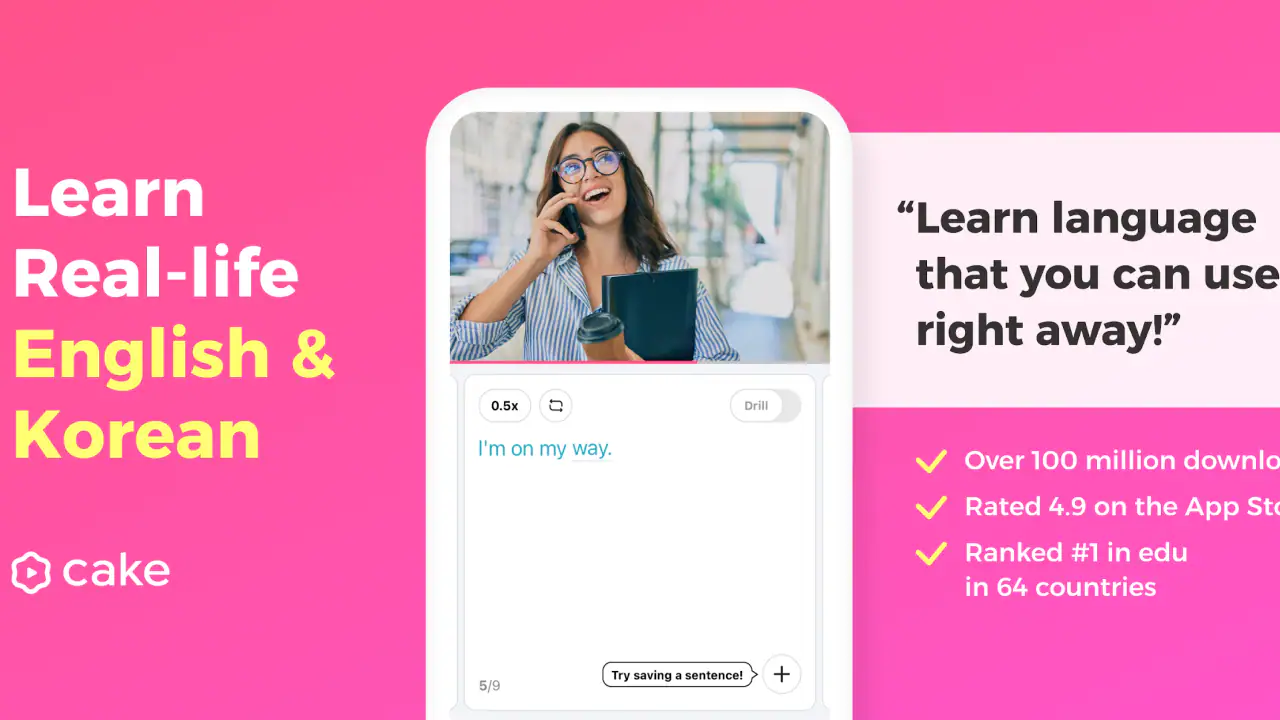
Cake - Learn English & Korean feels most useful when I treat it as a pocket practice tool rather than a complete language course. It is an Education app from Cake Corp. that puts real-life English and Korean expressions into short, approachable lessons, with examples connected to entertainment and everyday speech. I found that focus more motivating than a traditional sequence of grammar chapters, especially when I only had a few minutes to study.
The app is free to start, which makes it easy to try without committing money immediately. It is rated for Teen users, and its broad reach is reflected in an average rating of 4.7 from around 1.2 million ratings, alongside over 100 million installs. Those figures suggest that Cake has become a familiar choice for casual language learners, but popularity is not the same as suitability. Its strongest qualities appear when you want listening exposure, useful phrases, and a reason to return every day. It is less convincing as your only tool for structured grammar, formal writing, or serious exam preparation.
How Cake turns short clips into language practice
The central idea is simple: instead of presenting English or Korean as isolated vocabulary lists, Cake builds practice around expressions that sound like something a person might actually say. References to BTS, K-Pop, and K-Dramas give the lessons a recognizable cultural setting, which can make repetition feel less like homework. I especially liked this approach for noticing rhythm, shortened wording, and the difference between a sentence that is technically correct and one that sounds natural.
That does not mean every phrase should be copied into every situation. Entertainment language can be casual, emotional, or strongly tied to a particular relationship between speakers. My practical advice is to ask what kind of situation a sentence belongs to before using it with a teacher, manager, stranger, or older relative. Cake is good at showing language in context, but the learner still has to judge politeness and formality.
The short-lesson format also changes how I use it. I do not need to reserve a long block of time. A quick session while waiting for an appointment can cover a few expressions, and a longer session can be used to replay material and speak along with it. This makes the app a better match for inconsistent schedules than a course that expects the same study time every day.
Related News

Why WhatsApp Messenger Still Makes Everyday Communication Feel Easy

Jurassic World: The Game Is the Better Dino Tycoon for Strategic Players

Threads in Real Life: Who Should Join, Lurk, or Leave

How SHEIN Turned Shopping Into an Endless Content Feed

How to Make Fortnite Feel Smarter on Mobile

Should You Switch to Microsoft Outlook on Mobile?
What the entertainment focus does well
Music and drama clips can give a learner a stronger memory hook than a plain translation. When I hear a phrase attached to a scene or performer I already recognize, the intonation is easier to remember. That is particularly helpful for listening practice, because learners often know the written words but struggle when native speech runs them together.
There is also a useful emotional advantage. A learner who enjoys Korean pop culture may open Cake voluntarily, while a conventional textbook may remain untouched. That voluntary repetition matters. Exposure through several short visits can be more realistic than an ambitious study plan that collapses after a week.
The trade-off is that entertainment can distract from the language goal. I sometimes found myself paying more attention to the clip than to the sentence structure. To avoid that, I would first listen for meaning, then replay with the specific goal of catching pronunciation, and only afterward move on. This three-pass routine turns a quick video into deliberate practice without making the session feel heavy.
Gallery
Where it fits beside ordinary language apps
Compared with flashcard apps, Cake gives more attention to sound, timing, and conversational context. Flashcards are often better when I need to drill a fixed vocabulary set or review words in a controlled order. Compared with a full course, Cake feels lighter and more flexible, but it may not provide the same sense of progression through grammar, reading, and writing.
Compared with video platforms, it has a clearer learning purpose. Randomly watching clips can improve familiarity, but it does not automatically make me notice which phrase to repeat or what a sentence means. Cake narrows the experience toward language practice. Still, a dedicated pronunciation coach or structured textbook may be the better choice for learners who need detailed correction, formal writing tasks, or a carefully staged syllabus.
Connectivity changes when and how the app works
Because the experience is built around video-style lessons and interactive practice, my best sessions happen when the connection is stable. On a reliable network, moving from a clip to repetition feels smooth and immediate. That flow is important: the value of a short lesson comes partly from being able to listen again while the phrase is still fresh in my mind.
Network dependence becomes more noticeable in ordinary mobile situations. On public transport, in a crowded café, or in a building with weak reception, a lesson can become less convenient than it looked at home. Even a brief pause changes the rhythm of listening practice. I would not plan an important study session around Cake while travelling through areas where the connection is unpredictable.
I also recommend opening the app before the moment when you intend to study. This is not a claim that every lesson is available without a connection; it is simply a sensible habit for reducing surprises. If a lesson takes time to load, discovering that during a short break wastes much of the break itself. A quick check at home or on dependable Wi-Fi makes the mobile experience more predictable.
Using it in short mobile windows
Cake is particularly well suited to the small gaps that appear in a normal day. I can imagine using it after breakfast, during a lunch pause, or before bed when I want something more active than scrolling through social media. The important distinction is that I would use those moments for one clear task, such as listening closely to a phrase or repeating it aloud, rather than trying to complete a large amount of material.
Speaking aloud requires a little planning. A train carriage or shared office is not ideal for repetition, even if the lesson itself loads perfectly. In public, I would use the time for listening and silent recall, then repeat the expressions later in a private place. This two-stage workflow is one of the easiest ways to make the app fit real life without abandoning pronunciation practice.
Screen size also affects comfort. A phone is convenient for quick sessions, but longer viewing can feel tiring, especially when I replay the same clip several times. I prefer shorter rounds on mobile and save deeper review for a location where I can concentrate. Cake encourages casual access, but casual access should not be confused with effortless learning.
What happens when a session is interrupted
Mobile learning rarely happens without interruptions. A call, a change in reception, or simply closing the app can break concentration. My recovery method is to avoid treating an interrupted lesson as a failure. I return to the last phrase I clearly remember, listen once for meaning, and then repeat it. Starting from a known point is faster than trying to reconstruct the entire session.
If a clip does not load properly, I would switch tasks instead of repeatedly tapping the same screen. Reviewing a phrase already encountered, writing down a translation, or practising pronunciation from memory keeps the study habit alive while the connection problem passes. This is a small but important distinction: the app can support a routine, but the routine should not depend on every session being technically perfect.
For learners who need guaranteed continuity during flights, underground travel, or remote trips, this connectivity factor deserves serious attention. A conventional downloaded textbook, a locally stored audio course, or a dedicated offline-first tool may be a better companion in those settings. Cake is more attractive when online access is part of the normal environment.
Keeping mobile data under control
Video-oriented learning can consume more mobile data than text-only study, so I would use Wi-Fi for regular viewing whenever possible. This is especially sensible for learners who have a limited monthly allowance or share a connection with other people. I would also avoid opening a long lesson collection casually while away from Wi-Fi, because browsing can turn into more streaming than intended.
A practical routine is to study new clips on a dependable Wi-Fi connection and use mobile data mainly for a short review when necessary. I would also pay attention to how much time I spend replaying the same section. Repetition is valuable, but replaying without a specific listening goal is inefficient and may use data without improving recall. One replay for meaning, one for pronunciation, and one for active repetition is a more disciplined pattern.
Battery life is another part of the mobile equation. Video, audio, and a bright screen can make a short lesson more demanding than a text flashcard session. If my phone is already low, I would choose silent recall or handwritten review instead. Cake works best as one part of a study routine, not as the only activity available whenever the phone is in my hand.
Version, cost, and the decision to pay
The app is free, with optional in-app purchases ranging from $0.99 to $119.99 per item. That wide range means I would inspect any purchase screen carefully and decide what I actually need before paying. The free starting point is useful for testing whether the clip-based approach suits my attention span, learning goals, and internet access.
My recommendation is to use the free experience long enough to answer practical questions: Do I return to the lessons without forcing myself? Do I repeat phrases aloud, or only watch them? Does the connection where I live make the app convenient? If the answer is no, paying will not solve the underlying mismatch. If the method becomes a regular habit, an optional purchase may feel more reasonable, but I would still compare its value with a structured course or tutoring.
The current version is 6.7.0, and the app requires Android 7.0 or later. That makes compatibility worth checking before installing on an older phone. On supported devices, I would keep the operating system and app current where practical, particularly because a connection-heavy learning tool depends on stable playback and interaction. The developer is Cake Corp., and the app is available as a free Education title rather than a one-time paid product.
Who will benefit most from Cake
I would recommend it first to learners who want natural listening exposure and who already enjoy Korean pop culture or drama. It is also a good fit for someone restarting English after a long break, because the short format lowers the psychological barrier to beginning. Learners who dislike long explanations may appreciate seeing a phrase, hearing it, and trying it immediately.
It can also help an intermediate learner who understands written English but finds real speech too fast. Replaying a short expression gives that learner a manageable piece of listening material. For Korean learners, the cultural context may make repeated exposure more memorable, although the app should be paired with a resource that explains grammar and usage in greater depth.
I would be more cautious about recommending it to someone preparing for a formal examination, writing professional documents, or needing a complete beginner syllabus with carefully measured progression. A learner who wants teacher feedback, extended conversation, or detailed correction may outgrow the app quickly. It is also not the best choice for anyone whose study environment is regularly disconnected unless another resource is available for those periods.
A realistic routine that makes the app more useful
Here is the routine I would give a friend. On a stable connection, choose one short lesson and listen once without pausing. The goal is simply to understand the situation. Then replay it while watching the wording, identify one expression worth keeping, and say it aloud several times with the same rhythm. Finally, close the lesson and try to reconstruct the meaning from memory.
Later that day, I would use the expression in a personal sentence rather than replaying the entire clip automatically. For example, if the phrase relates to making plans, I would adapt it to something I might actually say to a friend. This step exposes whether I understood the expression or merely recognized it from the video. It also prevents entertainment context from becoming passive watching.
For a weekly review, I would collect a small group of expressions and sort them by situation: greetings, reactions, plans, disagreement, or encouragement. That organization is more useful than keeping a long undifferentiated list. It also reveals gaps. If most saved phrases are casual reactions from dramas, I would deliberately seek more practical language for work, travel, or study elsewhere.
The limitations I noticed in everyday use
The biggest limitation is not the quality of the idea but the risk of shallow practice. Short clips are easy to consume, and I can finish a session feeling productive without being able to produce the language later. The cure is active recall and speaking, neither of which happens automatically just because a lesson is entertaining.
The cultural focus can also narrow the range of language I encounter. BTS, K-Pop, and K-Dramas are strong entry points, but they do not represent every accent, age group, profession, or social setting. I would use Cake to build listening confidence and collect conversational expressions, then add news, graded reading, formal lessons, or live conversation to broaden my exposure.
Finally, connectivity adds friction at exactly the moments when mobile learning is supposed to be convenient. A stable connection makes the app feel immediate; a weak one can turn a five-minute plan into troubleshooting. That is not a reason to dismiss Cake, but it is a reason to pair it with a backup activity and to avoid assuming that every location will offer the same experience.
My connectivity verdict
After weighing the strengths and limits, I see Cake as a lively supplement for English and Korean practice, especially for listening and everyday expressions. Its entertainment-led lessons give me a reason to return, while the short format fits around real schedules. The free entry point makes experimentation easy, and the large user base shows that the approach resonates with many learners.
The best results come when I use Cake actively, on a reliable connection, and alongside a more structured resource. I would choose it for a learner who wants enjoyable daily exposure, not for someone seeking a complete academic curriculum in one app. If your phone is usually online and you are willing to repeat phrases aloud rather than only watch, it is worth trying. If you need dependable offline study, formal writing development, or detailed personal correction, a textbook, offline course, or teacher should take the lead instead.
In the end, Cake succeeds because it makes language practice feel close to ordinary media consumption while still giving the learner something concrete to repeat. I would keep it in my routine for short listening sessions and cultural motivation, but I would measure progress by what I can remember and say after the clip ends—not by how many lessons I have watched.
FAQs for Cake - Learn English & Korean
What is Cake and how does it help in learning languages?
Cake is an innovative language learning app designed to teach English and Korean through engaging bite-sized videos and interactive quizzes. By using real-life conversations and popular media clips, Cake helps users improve their pronunciation and comprehension skills. The app's unique approach focuses on practical language usage, making learning fun and effective.
Is Cake suitable for beginners or advanced learners?
Cake is ideal for learners at all levels, from beginners to advanced. The app offers a wide range of content tailored to different proficiency levels, allowing users to start at their own pace. Beginners can focus on basic vocabulary and phrases, while advanced users can dive into complex dialogues and nuanced language structures.
Does Cake offer any offline learning features?
Yes, Cake provides offline learning features for its users. You can download lessons and videos to your device and access them without an internet connection. This feature is particularly useful for users who want to continue learning while traveling or when they have limited access to the internet.
Is there a subscription fee for using Cake?
Cake offers a free version with access to a variety of lessons and features. However, there is also a premium subscription available, which unlocks additional content and advanced features. The premium version provides an ad-free experience, more detailed lessons, and personalized learning paths for a more comprehensive experience.
How does Cake ensure the accuracy of its language lessons?
Cake collaborates with language experts and native speakers to ensure the accuracy and quality of its language content. The app regularly updates its database with current and relevant material, providing users with accurate language models and practical usage. This commitment to quality helps learners acquire authentic language skills efficiently.
Pros
- User-friendly interface for easy navigation.
- Daily lessons keep learning consistent.
- Speech recognition for pronunciation practice.
- Diverse content for different proficiency levels.
- Offline mode for learning without internet.
Cons
- Limited advanced content for proficient users.
- In-app purchases can be pricey.
- Ads may interrupt free content.
- Occasional app crashes reported.
- Requires internet for some features.


